1. The film "Salmokji" (살목지) tells of a filming crew drawn to a real reservoir in Yesan, South Chungcheong, after a mysterious shape appears on a road-view capture, and it becomes a study of unexplained dread.
2. Director Lee Sang-min frames the story as a road-view horror: a team of seven encounters haunting, waterborne phenomena and the repeated phrase, “You cannot leave here alive.”
3. The story explores the border between ordinary reality and suffocating, seductive fear, inviting metaphors for spiritual and emotional entrapment.
4. For the church, the film can be a parable about confronting unknown fears, the temptation to surrender, and how God meets us at the water's edge.
5. This sermon will draw Scripture and pastoral reflection to help us name fear, find a faithful compass, and practice simple acts of courage and trust.
1. Encounter at the Edge: Salmokji and Our Littlest Steps
The crew in the film Salmokji follows a distorted road-view image to a real reservoir that already carries local rumor. In a quiet, ordinary task—re-shooting a road view—they find themselves at the brink of something that looks like a person beneath the surface. Like them, we often begin small errands, routine duties, or honest curiosity that lead us to the margins of things we do not understand. The first witness to fear is usually ordinary work or curiosity that becomes uncanny. In our lives, an unanswered email, a late-night worry, a recurring dream, or an unexpected diagnosis can be the road-view pixel that points us toward the reservoir. Lists help us see these ordinary beginnings:
- Small tasks that open into larger uncertainty
- Curiosity that becomes obsession
- Rumors or images that shape our expectations
2. The Shape of Unknown Fear: Naming What Lurks
In Salmokji the crew encounters sounds—ripples, stones, a voice from a ghost box—that do not answer to explanation. When the unknown takes shape we instinctively want a cause: a bad signal, a trick of light, a local legend. The film sets up a tension between rational investigation and the experience of being drawn under. In spiritual language, fear becomes a kind of current that tugs at our will and attention. Fear is not merely an emotion to dismiss; it is a current that wants to take our life directions. Consider these ways the unknown gains purchase on us:
- Repetition: the same sound, image, or thought that returns
- Isolation: fear grows when we are alone at the edge
- Suggestion: stories and rumors that fill the gaps
3. The Team and Our Stories: Company in the Deep
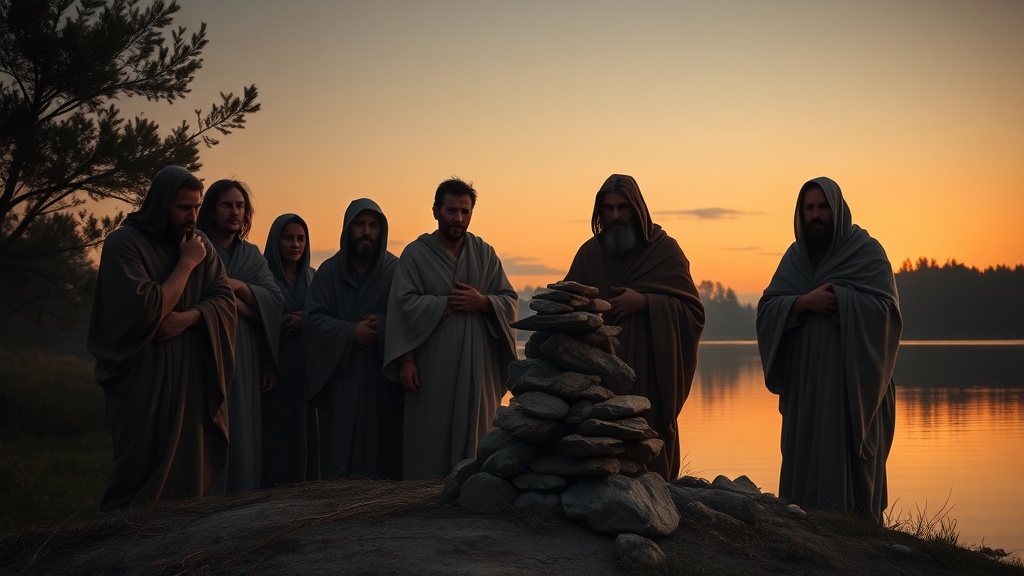
The seven people in the film represent nimble roles: leaders, skeptics, those who watch the cairn of stones, those who are drawn. In our congregations and families we have similar figures: the one who leads, the one who questions, the one who quietly remembers rituals. Community matters because no one should face the depth alone. The film’s repeated image of stacked stones—small cairns—reminds us of markers people leave when they pass or when they pray, and of practices that point beyond panic. Company is a sacrament against the abyss; we are not meant to contend with terror in isolation. Observe how the team acts:
- Some build: making cairns, trying rituals
- Some investigate: testing, measuring, explaining
- Some are pulled: attracted by the depth
4. Paths that Circle Back: When Navigation Fails
A striking element in the film is the broken navigation—vehicles circling, returning to the same spot, like a compass that spins. Spiritually, we know the experience: going round in the same patterns of worry, repeating the same decisions, feeling stuck. The crew’s attempts to flee only deepen disorientation. Yet Scripture promises a different kind of compass: God's presence that reorients. When our compass spins, God's Word steadies the needle toward mercy and meaning. Consider practical signs your life may be circling:
- Repeated conflicts with the same person
- Unaffected habits despite intention
- Increasing isolation despite busyness

5. Hope That Wades In: Scripture and Small Courage
Faith does not promise that we will never see strange shapes in the water. It promises a Presence who goes into the deep with us. The Psalmist says what we need to hear when the abyss seems near. In light of Salmokji's claim—"You cannot leave here alive"—we hear a countervoice that refuses despair and points to accompaniment and meaning. Courage is often a small, repeated fidelity more than a single heroic act. Practical practices include building simple cairns of remembrance, naming fears to trusted companions, and choosing a steady, daily act that reorients the heart.
- Remember: God has been present at thresholds before
- Practice: small rituals mean something
- Reach: invite company, resist isolation
