The film Fin imagines a near-future unified Korea.
It asks what it means to live with those who are different.
The “Omega” beings symbolize marginalized lives under pressure.
Its dystopian world warns us against fear, control, and exclusion.
The Bible calls us to honor human dignity, mercy, and peaceful coexistence.
1. A Future World That Mirrors the Present
The film Fin is set in a near-future unified Korea, but its power does not come only from its futuristic background. It comes from the questions it places before us. What happens when a society meets people who are different by birth? What happens when fear begins to shape public life? What happens when a human community decides that some lives are easier to manage than to welcome? These are not merely science-fiction questions. They are moral questions, and they speak to the condition of every age. A dystopian story often feels distant, yet it often reflects today more honestly than we would like. The film’s world of genetic mutation, social tension, and uneasy coexistence becomes a mirror, showing how quickly compassion can weaken when order becomes more important than mercy.
- Dystopia often reveals hidden fear.
- Future settings expose present moral failures.
- Difference can become a test of character.
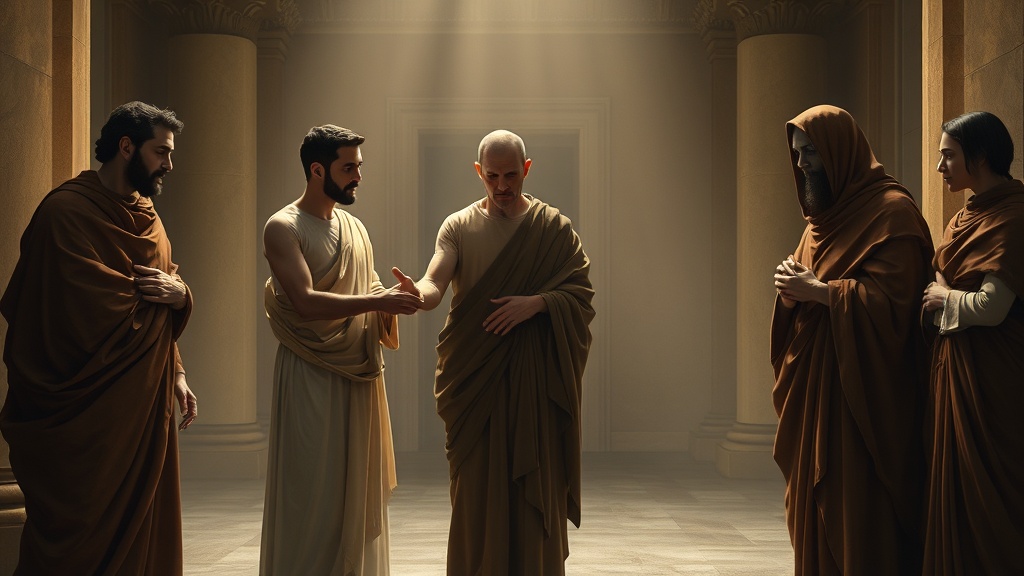
2. The Omega and the Question of Human Worth
The central figure of the film’s setting is the genetically mutated being called Omega. In the language of the story, the Omega is different in origin, different in appearance, and likely treated as a social exception. Yet the deeper issue is not mutation itself. The deeper issue is how a community decides the value of a person. Scripture teaches that human worth is not founded on usefulness, strength, beauty, or conformity. Human life is precious because it is created by God. For that reason, anything that reduces a person to a label, category, or biological condition must be resisted. The Bible does not ask us to admire sameness; it calls us to honor persons. This is why the film can be preached about wisely: it gives us a modern picture of the ancient temptation to rank people by visible difference. When fear rules, the vulnerable are judged before they are known.
- Worth is given by God, not by society.
- Labels are never a full measure of a person.
- Different does not mean less valuable.
3. Companionship, Not Control
One of the most important themes in this story is coexistence. The film does not merely ask whether humans and the Omega can live in the same society. It asks under what spirit they can live together. Coexistence is not achieved through tolerance alone, and it is certainly not achieved through domination. Real shared life requires humility, patient listening, and just boundaries. In a fallen world, people often seek control because control feels safer than trust. Yet the Gospel shows a different path: love that does not erase difference, but carries difference with grace. The church is called to be a place where people are not sorted by status and where the weak are not treated as a burden. This is why the story’s tension matters. A society that builds peace by suppressing the vulnerable may look stable for a moment, but it has already lost its soul.
- Coexistence requires respect.
- Control may produce order, but not peace.
- Love protects without humiliating.

4. The Sin of Exclusion and the Call to Mercy
Many dystopian stories become memorable because they expose what happens when exclusion becomes normal. The film’s world appears to be one where genetic difference can become a reason for suspicion, regulation, or distance. That pattern is sadly familiar in human history. People fear what they do not understand, and fear can harden into exclusion very quickly. The Bible repeatedly warns against this kind of heart. James teaches believers not to show partiality, and the prophets call God’s people to defend the oppressed. Mercy is not sentimental weakness; it is covenant faithfulness in action. To be merciful is to refuse the lie that only the strong belong. In that sense, the film’s uneasy atmosphere can become a spiritual warning. Whenever a community begins to think some lives are more deserving of dignity than others, that community is walking away from God’s heart.
- Exclusion begins with fear.
- Favoritism destroys communal trust.
- Mercy restores the dignity of the overlooked.
5. Living as a People of the Kingdom
The final message we can draw from this film is not panic, but calling. The kingdom of God is not built on fear of difference; it is built on the reconciling work of Christ. In Christ, we learn that fellowship is deeper than similarity, and love is stronger than suspicion. The church therefore becomes a living contrast to the dystopian spirit of the age. We are called to be a people who recognize every person as a bearer of God’s image, who welcome those the world prefers to ignore, and who refuse to measure human value by genetic strength, social utility, or visible success. This is not always easy, but it is holy work. The film’s title, Fin, can remind us of the fragility of life, like a small fin moving through rough waters. Yet the Lord who made the sea also guides His people through it. So let us choose honor over contempt, communion over isolation, and love over fear.
- The kingdom of God lifts up the lowly.
- Christ makes room for those the world excludes.
- Christian witness is seen in humble, steady love.
