When power grows, restraint must grow with it.
The pursuit of justice must never abandon due process.
Institutions are strongest when they remain accountable and independent.
Public trust is built not by force, but by fairness and truth.
God calls His people to love mercy, do justice, and walk humbly.
When Justice Is Watched, the Heart Must Stay Humble
The news of a committee formed under the Ministry of Justice to review prosecutorial matters, and the concern that such a body may weaken judicial independence and the rule of law, may sound distant from a Sunday sermon. Yet beneath the legal language lies a question that every generation must face: How do we handle power without losing righteousness? Whether in government, in the home, in the workplace, or in the church, human authority is never self-justifying. It must remain under discipline. Scripture does not ask us to ignore justice; it teaches us to love it. It does not tell us to worship institutions; it teaches us to fear God more than human applause. That is why this moment invites reflection, not partisanship. We are not here to campaign for a side, but to remember that truth, fairness, and restraint are holy words before they are public words.
- Justice must be guided by truth, not by pressure.
- Power must be checked by conscience.
- Public trust grows where fairness is visible.
- Any system that judges others must itself be judged by righteousness.
The Bible Teaches Measuring, Not Manipulating
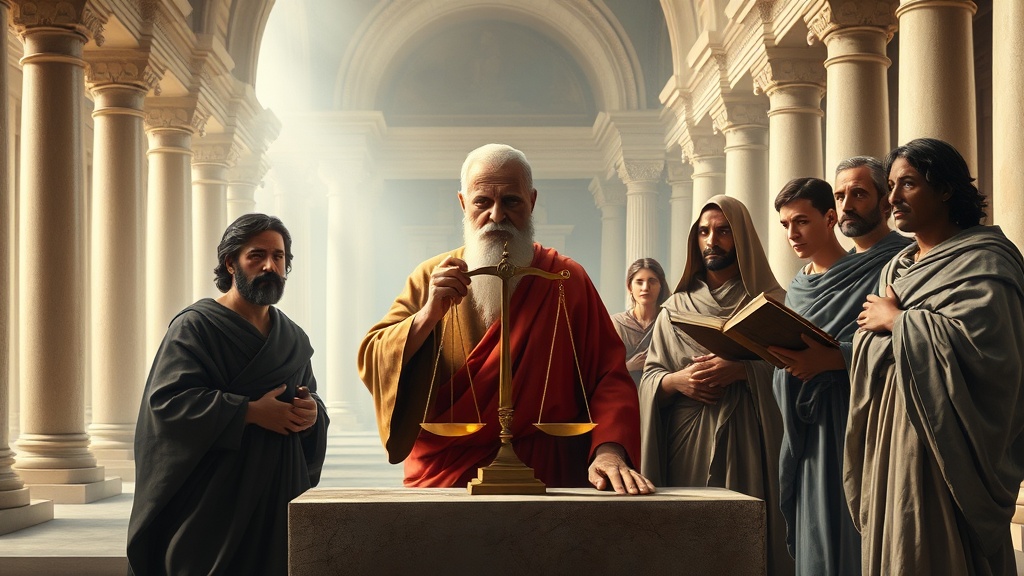
One of the central concerns in this issue is the scope of authority: who may examine whom, under what limits, and for what purpose. That is not only a legal question; it is also a spiritual question. The Bible repeatedly warns against dishonest scales, partial judgment, and words that bend truth. In old Israel, a false weight was not merely a commercial error; it was a moral offense. Likewise today, when oversight becomes overreach, people lose confidence not only in a process but in the very idea of justice. The temptation of every powerful institution is to believe that its cause is so important that ordinary limits no longer apply. But the Lord never blesses a shortcut that corrupts fairness. God’s justice is never careless, never noisy, and never afraid of the light.
- Justice is not only an outcome; it is a way of acting.
- Humble leadership asks whether its methods are clean.
- Truth does not need exaggeration to stand firm.
- A righteous society begins with righteous hearts.
Independence Is Not Pride; It Is Protection
Some may hear the word independence and think of distance, resistance, or self-importance. But in the moral life, independence is often a protection for justice. It means that a judge, an investigator, or any public servant must be free from improper pressure so that truth may be heard clearly. The concern raised by former prosecutors about judicial independence and the rule of law points to a real danger: when a state body appears to be reaching into a specific case, people may wonder whether decisions are being reviewed for fairness or for influence. Scripture teaches that leaders are accountable, but it also teaches that authority must not be used to crush the weak or bend judgment. In the church, too, we learn this principle: healthy authority is not domination, but stewardship. Where independence is respected, trust can grow; where it is violated, fear begins to speak louder than truth.

- Independence protects conscience from coercion.
- Accountability without fairness becomes suspicion.
- Wise oversight examines systems, not persons for revenge.
- Trust is fragile and must be guarded with care.
The Rule of Law Needs More Than Rules
People often say that the rule of law means having laws on paper. But in biblical wisdom, law is not merely a document; it is a moral order that protects the neighbor, limits the strong, and gives the weak a voice. That is why legal debates become spiritual debates so quickly. If the rules are used selectively, the poor suffer, the honest become cynical, and the community begins to fracture. Yet if the rules are honored with consistency, peace has room to breathe. The present controversy reminds us that the law must not become a tool for humiliation, nor a shield for arrogance. It must serve truth. It must serve justice. It must serve the common good. And ultimately, it must answer to the One who sees every hidden motive. A society is not truly strong when it wins every argument; it is strong when it can still be fair under pressure.
- Law should guide power, not decorate it.
- Procedure matters because people matter.
- Fairness is not weakness; it is moral strength.
- When truth is honored, peace becomes possible.
A Christian Response: Pray, Discern, and Walk Humbly
So how should the people of God respond when public life is troubled by questions of authority, independence, and trust? First, we pray, because no earthly institution can heal what only God can heal in the human heart. Second, we discern, because not every claim is equally true and not every reform is automatically righteous. Third, we walk humbly, because the moment we become certain that we alone stand above scrutiny, we have already lost the spirit of Christ. In a tense age, the church must be careful not to become a loud echo of the world. Instead, we should become a quiet witness to a better way. We can support fairness without hatred, accountability without vengeance, and reform without contempt. The Lord does not call us to defend darkness or to excuse injustice; He calls us to be children of light.
- Prayer softens anger and opens the way for wisdom.
- Discernment helps us avoid rash conclusions.
- Humility keeps us faithful when public speech becomes harsh.
- Righteousness is more precious to God than religious appearance.
